
White Grunt
Haemulon plumierii
A red-mouthed reef school makes its name by grunting.
White Grunts rest in close schools over reefs and sandy bottoms during the day. After sunset, they spread into seagrass, sand, and mud to search for small animals.
Find this SeaPal in the card gallery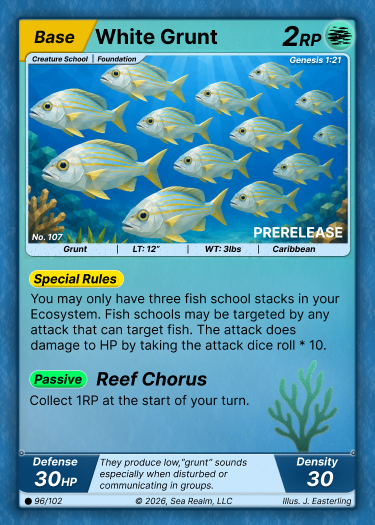
From field guide to game table
Bring this White Grunt home
See which ready-to-play decks feature this SeaPal. Try one in the simulator before you buy, or explore each full deck list.
- 2 copies
Ready-to-play deck
Blue Water Deck
Includes 2 cards featuring White Grunt.
- 2 copies
Ready-to-play deck
Murky Water Deck
Includes 2 cards featuring White Grunt.
Quick dive
Creature passport
- Home
- Western Atlantic reefs and nearby seagrass beds from the Chesapeake Bay and Gulf of Mexico through the Caribbean to Brazil.
- Favorite foods
- Crustaceans, mollusks, echinoderms, and small fishes; juveniles also pick tiny plankton from the water.
- Size check
- Commonly about 17 in (45 cm) - a little longer than a laptop
Tell-your-friends facts
Four wonderfully wild things
- 1
The inside of a White Grunt's mouth is bright red.
- 2
Young fish may shelter among the long spines of sea urchins.
- 3
Its colors can fade toward pale yellow to better match nearby sand or coral.
- 4
Two White Grunts may push open mouths together during a territorial display.
Ocean superpower
Built to be amazing
Throat teeth grind together while the swim bladder amplifies the sound into a grunt.
Junior scientist tip
What should I look for?
Look for a silvery body, blue-striped head, forked tail, and red mouth.
Grown-up research links
We used trusted science organizations to check this profile.