
Tripletail
Lobotes surinamensis
A sideways leaf disguise hides three pretend tails.
Tripletails often float on their sides near seaweed or debris, pretending to be a drifting leaf. Rounded rear fins frame the real tail and create the illusion of three tails.
Find this SeaPal in the card gallery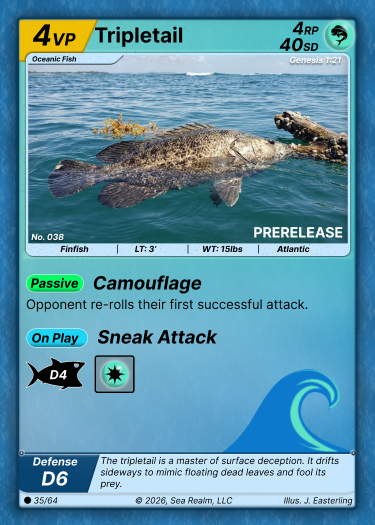
From field guide to game table
Bring this Tripletail home
See which ready-to-play decks feature this SeaPal. Try one in the simulator before you buy, or explore each full deck list.
Not currently in a ready-to-play deck
You can still find this SeaPal in the card gallery while planning your own custom deck.
Quick dive
Creature passport
- Home
- They use tropical and subtropical bays, estuaries, offshore water, and floating cover worldwide.
- Favorite foods
- They ambush small fishes, shrimp, crabs, and other crustaceans.
- Size check
- Up to about 3.6 ft (1.1 m)—baseball-bat length
Tell-your-friends facts
Four wonderfully wild things
- 1
The soft dorsal and anal fins look like two extra rounded tails.
- 2
Juveniles may be yellow, mottled, or dark brown like floating leaves.
- 3
Young tripletails often shelter in drifting Sargassum.
- 4
They can tolerate both full seawater and brackish estuaries.
Ocean superpower
Built to be amazing
Sideways leaf mimicry lets a patient hunter drift close to unsuspecting prey.
Junior scientist tip
What should I look for?
Look for a leaf-like fish floating sideways beside a buoy, log, or seaweed.
Grown-up research links
We used trusted science organizations to check this profile.