
Sardine Ball
Sardinops sagax
A silver swirl that makes predators dizzy.
Pacific sardines form dense schools and feed on plankton. Length and weight describe one fish, not the entire school. This card represents the pacific sardine.
Find this SeaPal in the card gallery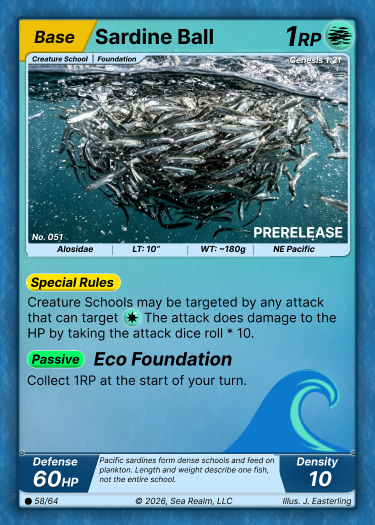
From field guide to game table
Bring this Sardine Ball home
See which ready-to-play decks feature this SeaPal. Try one in the simulator before you buy, or explore each full deck list.
- 8 copies
Ready-to-play deck
Pelagic Zone Deck
Includes 8 cards featuring Sardine Ball across 3 card versions.
Quick dive
Creature passport
- Home
- Northeastern Pacific coastal waters from western North America into the Gulf of California.
- Favorite foods
- They eat tiny plankton, including drifting animals and microscopic algae.
- Size check
- Card reference: length 10”; weight ~180g. Length and estimated weight describe one fish. Weight is calculated from a published length–weight model.
Tell-your-friends facts
Four wonderfully wild things
- 1
Each fish follows nearby neighbors rather than a single school leader.
- 2
A dark back and pale belly camouflage sardines from above and below.
- 3
Sardines are important food for seabirds, marine mammals, and larger fishes.
- 4
Their lateral-line sensors detect vibrations and nearby movement in the water.
Ocean superpower
Built to be amazing
Thousands of neighbors can turn together in an instant and confuse attackers.
Junior scientist tip
What should I look for?
Watch for a flashing silver cloud that ripples and changes shape.
Grown-up research links
We used trusted science organizations to check this profile.