
Oysters
Ostreidae
Living water filters that build bustling shell cities.
Oysters draw water across their gills, trapping tiny food while helping clear the water. Generations attach to older shells and build rough reefs filled with hiding places for fish and crabs.
Find this SeaPal in the card gallery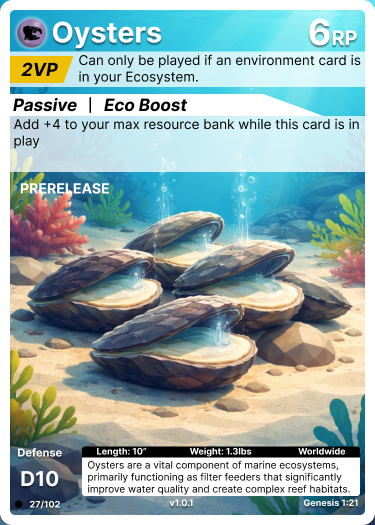
From field guide to game table
Bring these Oysters home
See which ready-to-play decks feature these SeaPals. Try one in the simulator before you buy, or explore each full deck list.
- 2 copies
Ready-to-play deck
Blue Water Deck
Includes 2 cards featuring Oysters.
- 1 copy
Ready-to-play deck
Coral Garden Deck
Includes 1 card featuring Oysters.
Quick dive
Creature passport
- Home
- Shallow salty and brackish coasts, bays, estuaries, and tidal creeks worldwide.
- Favorite foods
- Microscopic algae and organic particles filtered from the water.
- Size check
- Often 3–10 in (8–25 cm), depending on species and age
Tell-your-friends facts
Four wonderfully wild things
- 1
Oysters are bivalves, meaning two shells hinge together.
- 2
Free-swimming larvae become spat after cementing to a hard surface.
- 3
Young oysters often settle directly on older oyster shells.
- 4
Reef crevices shelter small fishes, shrimp, crabs, and other animals.
Ocean superpower
Built to be amazing
Under good conditions, one adult can filter up to 50 gallons daily.
Junior scientist tip
What should I look for?
Find clusters of rough, uneven shells cemented together in shallow water.
Grown-up research links
We used trusted science organizations to check this profile.