
Giant Tube Worm
Riftia pachyptila
Friendly bacteria power a mouthless vent giant.
The giant tube worm grows beside volcanic seafloor vents where poisonous-looking chemicals pour out. It has no mouth or stomach because bacteria living inside make all its food.
Find this SeaPal in the card gallery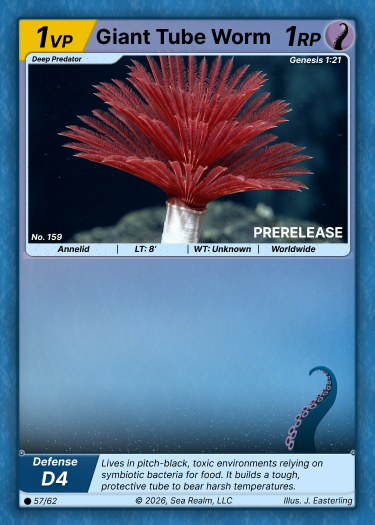
From field guide to game table
Bring this Giant Tube Worm home
See which ready-to-play decks feature this SeaPal. Try one in the simulator before you buy, or explore each full deck list.
Not currently in a ready-to-play deck
You can still find this SeaPal in the card gallery while planning your own custom deck.
Quick dive
Creature passport
- Home
- It forms colonies at hydrothermal vents in the eastern Pacific, about 1,900 to 3,600 meters deep.
- Favorite foods
- It does not eat; symbiotic bacteria make food from vent chemicals.
- Size check
- Up to about 6.6 ft (2 m)—taller than most adults
Tell-your-friends facts
Four wonderfully wild things
- 1
An adult has no mouth, gut, or anus.
- 2
Its red plume absorbs oxygen and hydrogen sulfide for the internal bacteria.
- 3
The worm snaps its soft plume inside the white tube when danger appears.
- 4
Free-swimming larvae help the species discover and settle newly formed vents.
Ocean superpower
Built to be amazing
Billions of inner bacteria use chemosynthesis to turn chemicals into food.
Junior scientist tip
What should I look for?
Look for a long white tube topped by a bright red feathery plume.
Grown-up research links
We used trusted science organizations to check this profile.