
Blue Crab
Callinectes sapidus
A sideways swimmer with blue claws and paddle feet.
Blue Crabs scuttle and swim through bays using their flattened rear legs like paddles. They are quick, curious omnivores that investigate almost anything edible on the bottom.
Find this SeaPal in the card gallery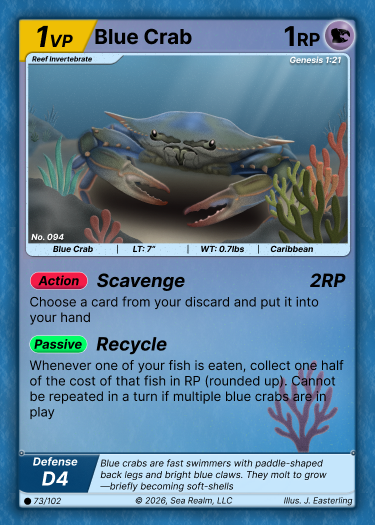
From field guide to game table
Bring this Blue Crab home
See which ready-to-play decks feature this SeaPal. Try one in the simulator before you buy, or explore each full deck list.
- 2 copies
Ready-to-play deck
Blue Water Deck
Includes 2 cards featuring Blue Crab.
- 2 copies
Ready-to-play deck
Disruption Deck
Includes 2 cards featuring Blue Crab.
- 2 copies
Ready-to-play deck
Coral Garden Deck
Includes 2 cards featuring Blue Crab.
- 1 copy
Ready-to-play deck
Murky Water Deck
Includes 1 card featuring Blue Crab.
Quick dive
Creature passport
- Home
- Western Atlantic estuaries, seagrass beds, marshes, bays, and coastal shallows.
- Favorite foods
- Clams, oysters, worms, small animals, carrion, plants, and detritus.
- Size check
- Shell up to about 9 in (23 cm) across — dinner-plate width
Tell-your-friends facts
Four wonderfully wild things
- 1
Its scientific name means beautiful savory swimmer.
- 2
Adult males have blue claws; mature females often have red-orange tips.
- 3
A soft-shell crab is simply a blue crab soon after molting.
- 4
Females move toward saltier water before releasing their larvae.
Ocean superpower
Built to be amazing
Paddle-shaped back legs turn a bottom-walking crab into a strong swimmer.
Junior scientist tip
What should I look for?
Spot olive shell, blue claws, side spikes, and rear swimming paddles.
Grown-up research links
We used trusted science organizations to check this profile.